Three members of the CERISE project attended the Pan-GLASS conference 2026 Pan-GLASS Conference | GEWEX Events in Stuttgart 6th to 9th July 2026.
In the session “Observing, understanding, and parameterizing turbulence and surface fluxes at the land-atmosphere interface”, Monalisa Sahoo (BSC) and Jonny Day (ECMWF) both presented posters and Gabriel Narvaez-Campo (MF) gave a presentation.
Monalisa Sahoo | Poster | Spatiotemporal Evolution of Land–Atmosphere Coupling Associated with Mediterranean Heatwaves |
Jonny Day | Poster | Soil-moisture's influence on the leading mode of northern hemisphere circulation |
Gabriel Narvaez-Campo | Presentation | Vegetation observations reshape global water–energy simulated fluxes: Hydrological impacts of Leaf-Area-Index data assimilation |
Monalisa Sahoo BSC comments:
"I presented a poster titled “Spatiotemporal Evolution of Land–Atmosphere Coupling Associated with Mediterranean Heatwaves."
The study finds where there is high terrestrial coupling over Mediterranean region, leads to the rapid intensification of the land-atmospheric coupling using segmented regression method and Bayesian Information Criteria. This intensified coupling leads to soil moisture reaching its critical point and hence rapid change in daily maximum temperature afterwards. During the poster session, there were interesting discussions with other participants who did similar study analyses in different regions eg. Korea, USA and India. As the study is primarily based on observation-based data, we got suggestions about looking into how different LSMs are performing in capturing these phenomena."
Jonny Day remarks:
"I presented a poster with the title "Soil Moisture’s Influence On The Leading Mode Of Northern Hemisphere Summer Circulation."
The poster explored how soil moisture anomalies can help shape the leading mode of Northern Hemisphere summer atmospheric circulation. Using sensitivity experiments, I showed that La Niña-like soil-moisture anomalies over North America can drive a circumglobal wave response, suggesting that ENSO may exert a delayed influence on Northern Hemisphere summer circulation through a land-surface pathway involving soil-moisture persistence and soil-moisture precipitation coupling.
The poster session was very active and I enjoyed some interesting discussions about the work."
Gabriel NARVAEZ CAMPO states:
"I am pleased to share that I presented part of our work at Pan-GLASS 2026 - The presentation was entitled: “Vegetation observations reshape global water–energy simulated fluxes: Hydrological impacts of Leaf-Area-Index data assimilation.”
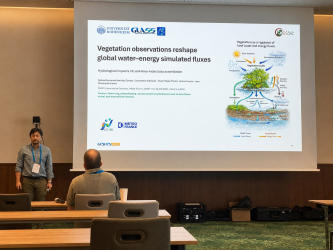
In the talk, I presented a global assessment of the hydrological impacts of assimilating LAI into the ISBA–CTRIP modelling framework. The study compared two controlled simulations — an open-loop configuration with freely evolving LAI and an LAI-constrained experiment using GEOV2-AVHRR — over the 1982–2017 period and across 2,139 gauged basins worldwide.
The main message was that vegetation observations do not simply “improve hydrology” uniformly. Instead, they reshape the pathways through which water and energy errors propagate. The strongest and most coherent impacts were found for evapotranspiration and snow water equivalent, while the streamflow response was more muted and regime-dependent due to compensation among flux, storage, and forcing errors.
I also emphasized the relevance of a hydro-biospheric regime framework to interpret where LAI assimilation can most effectively improve water–energy fluxes, and where additional constraints, such as snow, soil moisture, and precipitation correction, will likely be needed."
We thank all three for attending and presenting the CERISE results and analysis.
Photos courtesy of the project team.
The Pan-GLASS conference:
A summary from the 2026 Pan-GLASS Conference | GEWEX Events website page:
The GEWEX Global Land-Atmosphere System Studies Panel (GLASS) held its first Pan-GLASS Conference “Back to the Drawing Board: From Fundamentals to Improved Models of the Coupled Land-Atmosphere System” (Pan-GLASS 2026) in Stuttgart from 06-09 July 2026.
The conference was organized and performed by the Institute of Physics and Meteorology of the University of Hohenheim in Stuttgart, Germany, and the GLASS Panel with support of the International GEWEX Project Office
Pan-GLASS 2026 brought together experts on earth system and weather research, soil and vegetation processes, surface fluxes, planetary boundary layer transport processes, clouds and precipitation, and machine learning. The key objectives of this conference were to connect the land-atmosphere interactions community as well as to achieve progress in the understanding and modeling of the land-atmosphere system, to coordinate current international initiatives and make plans for the future.